Log018
What Is Faro? The Card Game Behind "Bucking the Tiger"
- Logged
- Reading time
- 5 min
- Section
- E Casino History
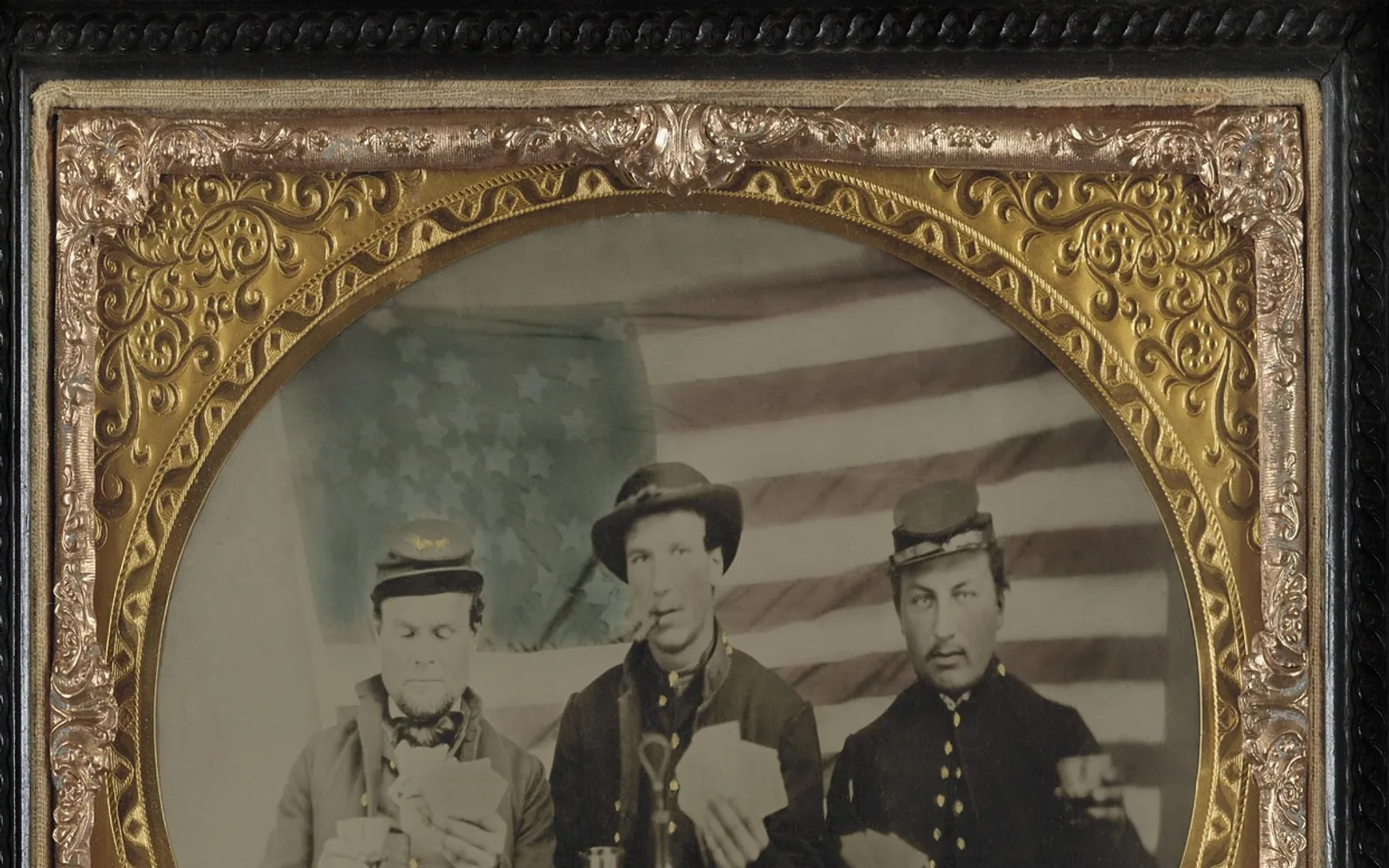
Faro is an old banking card game in which players stake money on card ranks laid out on a board, while a dealer draws cards from a box two at a time: the first card of each pair loses for anyone who backed its rank, the second wins. The game came from France, was fashionable in Georgian England and became the dominant gambling game in nineteenth-century America, from city gaming houses to mining-camp saloons. Playing against the bank was called "bucking the tiger". Today faro lives on mainly in museums, history books and the odd heritage event.
From basset to pharaon
Faro grew out of basset, a banking game played in Italy and France in the seventeenth century. Its French successor, pharaon, appeared late in that century; the name is usually linked to a pharaoh design that decorated certain French court cards, although the evidence for that is thin. French authorities banned both games more than once, without much lasting effect. English society took up "pharo" in the eighteenth century, the spelling drifted to faro, and the game sailed to North America, where it found its largest audience.
How a game of faro was dealt
The rules are simple once the equipment makes sense. A typical American faro bank worked like this:
- The layout. Thirteen cards of one suit, usually spades, were fixed to a board on the table. Suits did not matter in faro, only ranks.
- Placing bets. Players put chips on any rank, or between ranks to cover several at once. To bet that a rank would lose instead of win, a player "coppered" the stake by setting a small token on top of it.
- The box. A shuffled deck went face up into an open-topped dealing box. The top card, called the soda, was shown and took no part in the betting.
- The turns. The dealer drew two cards per turn. The first, the banker's card, lost for every bet on its rank. The second, the player's card, won for every bet on its rank. All other stakes stayed where they were and could be moved before the next turn.
- Splits. When both cards of a turn were the same rank, the bank took half of the money staked on that rank. In an honest game this was the house's main source of profit.
- The last turn. With three cards left, players could "call the turn" by naming their exact order. The bet usually paid four to one, although three different cards can come out in six possible orders. The final card was known as the hock.
Beside the dealer sat the casekeeper, an assistant working a device like an abacus that showed which cards of each rank had already appeared. Faro was dealt without reshuffling mid-deck, so this record was genuinely useful: a rank with only one card left could no longer be split, which is part of why an honest faro bank ran on such a thin margin.
The tiger on the sign
Nobody is quite sure why faro became tied to the tiger. Dealing boxes and chip cases were often decorated with one, and gaming houses are said to have hung a tiger picture outside to tell passers-by that a faro bank was open inside. "Bucking the tiger" meant playing against that bank, and streets lined with faro rooms were nicknamed "tiger town" in more than one American city. Frontier figures such as Doc Holliday are remembered partly as faro dealers, and the game ran around the clock in the boomtowns that grew up after the steamboat era described in our history of riverboat gambling.
A faro glossary
| Term | Meaning at the table |
|---|---|
| Faro bank | The game itself, or the house money that players bet against |
| Soda | The first exposed card, which did not count |
| Coppering | Placing a token on a stake to bet that the rank would lose |
| Split | Two cards of the same rank in one turn; the bank took half |
| Casekeeper | The assistant, or the device, tracking cards already dealt |
| Calling the turn | Naming the order of the last three cards |
| Hock | The last card left in the box |
| Bucking the tiger | Playing faro against the bank |
Why faro disappeared
A game that dominated a century did not fade for a single reason. Several pressures worked together:
- Crooked equipment. Because the honest game gave the bank so little, rigged dealing boxes that let a dealer control which card came out next were built and advertised in gambling-supply catalogues of the period. Faro's reputation never recovered.
- Thin margins. Licensed casinos preferred games with a dependable built-in edge, and an honest faro bank could not offer one.
- Law and reform. Anti-gambling campaigns of the late nineteenth and early twentieth centuries shut many faro houses for good.
- Competition. Poker and twenty-one, the game we follow in vingt-et-un and the roots of blackjack, kept the players faro lost.
Some Nevada casinos still offered faro after the state legalised gambling in 1931, but the tables grew rarer each decade, and by the 1980s the game had all but vanished from casino floors.
What faro players got wrong
Faro rooms were full of systems: favourite ranks, sequences scribbled on cards, beliefs about which cards were "running". The casekeeper gave real information, but most of the systems built on top of it were the same pattern-hunting described in our article on the illusion of control in gambling. Players who had been bucking the tiger all night also had every reason to keep going in the hope of winning back what they had lost, the trap set out in our piece on the sunk cost fallacy.
Can you still play faro?
It is no longer a standard casino game. People mostly meet it at historical reenactments, in museum displays of dealing boxes and casekeepers, or in a home game dealt from an ordinary deck for the sake of curiosity.
Does "in hock" come from faro?
The idea is popular because the last card was called the hock. Dictionaries tend to point to other roots, such as an older Dutch word for a pen or prison, so the faro version is best treated as a colourful theory.
The tiger has left the building, but the arithmetic that fed it has not. Any game played for money is for adults only and only where local law permits it; fix the evening's budget before the first bet, and if gambling has started costing more than the fun is worth, speak to a support service near you.