Log015
Vingt-et-Un: How a French Card Game Became Blackjack
- Logged
- Reading time
- 4 min
- Section
- E Casino History
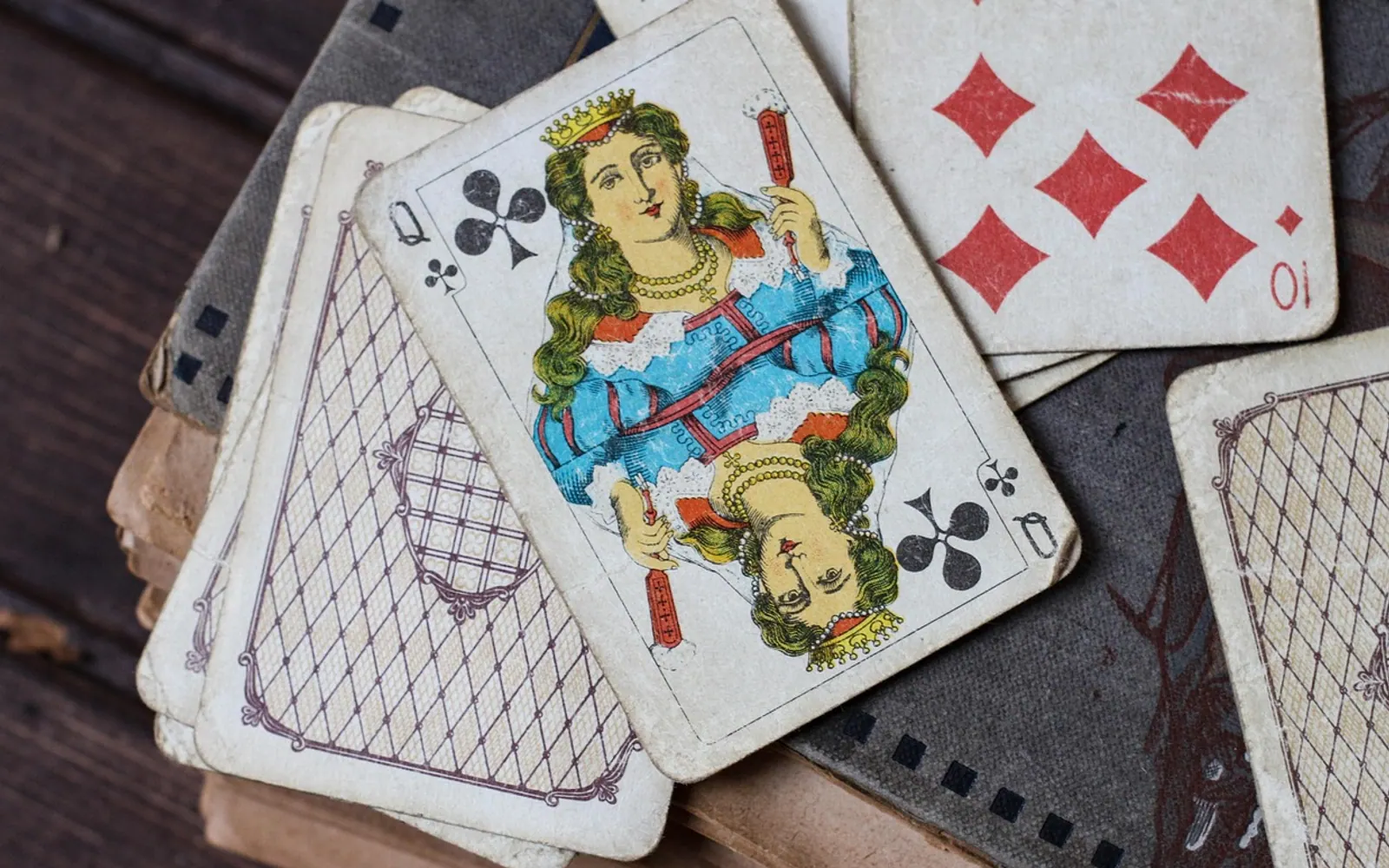
Vingt-et-un is French for "twenty-one", and it names the card game that grew into modern blackjack: players draw cards hoping to finish closer to 21 than the banker without going over. Nobody is on record as its inventor. Versions of the game were known in Spain and France by the early seventeenth century, travelled to Britain, where it became Pontoon, and reached North America as Twenty-One. The word "blackjack" arrived much later and probably owes more to marketing than to the rules.
The first trace: a story from Seville
The oldest written mention usually cited comes from Miguel de Cervantes. In "Rinconete y Cortadillo", one of the short novels he published in 1613, two young cardsharps from Seville talk about a game called veintiuna. Its aim is to reach twenty-one without passing it, and the ace can count as one or eleven. Because Cervantes drops the game into the story without explaining it, readers of his day were presumably expected to know it already, which pushes its origins further back than the book.
Vingt-et-un in France
In France the game was played under the name vingt-et-un in private houses and gaming rooms through the eighteenth and nineteenth centuries. Its rules were looser than a modern casino's. In many recorded versions the role of banker did not belong to the house at all but passed around the table, often to the next player who was dealt a two-card twenty-one, known as a natural. The banker carried the risk and the advantage of acting last, so holding the bank was something players competed for rather than something they sat across from. Rules on doubling, splitting and what the banker had to draw varied from one table to the next.
Pontoon: the British branch
British players adopted the French game and, in time, wore its name down into "Pontoon". The household version that is still dealt around kitchen tables keeps the rotating bank and has its own vocabulary:
- Twist — take another card face up.
- Buy — take another card face down by adding to the stake.
- Stick — stop drawing.
- Pontoon — an ace plus a ten-value card, the best hand.
- Five-card trick — five cards totalling 21 or less, which beats everything except a pontoon.
| Feature | Pontoon (home game) | Casino blackjack |
|---|---|---|
| Who holds the bank | Passes between players | Always the house |
| Banker's cards | Both dealt face down | One card dealt face up |
| Taking a card | "Twist" or "buy" | "Hit" |
| Stopping | "Stick" | "Stand" |
| Best hand | Pontoon, then a five-card trick | Blackjack (a natural) |
| Dealer's drawing | The banker chooses | Fixed house rule |
Why is it called blackjack?
The explanation repeated most often is that American gambling halls, trying to draw players to a game that was slow to catch on, offered a bonus payout for a hand made of the ace of spades and a black jack. The bonus disappeared, the story goes, but the nickname stayed attached to the game. Card historians treat this with some caution, because the bonus is hard to document and the word "blackjack" had other uses in American slang. What is clear is that by the twentieth century "blackjack" and "twenty-one" were used for the same casino game, and the name of the best hand had become the name of the whole thing.
From back rooms to the Nevada floor
Twenty-one was dealt in American gambling halls through the nineteenth century, often in the same rooms as faro, the banking game that ruled the era. When Nevada legalised most forms of gambling in 1931, the game moved into licensed casinos and took on its modern shape. The bank stopped rotating, the dealer became an employee following fixed rules about when to draw, and one of the dealer's cards was turned face up so players had something to decide against.
The mathematicians arrive
Those fixed rules made blackjack something unusual among casino games: a puzzle that could be solved. In 1956 four mathematicians serving in the US Army, Roger Baldwin, Wilbert Cantey, Herbert Maisel and James McDermott, published a paper setting out the best play for each player hand against each dealer card, the ancestor of today's basic strategy charts. In 1962 Edward O. Thorp's book Beat the Dealer showed that tracking the cards already played could, in some situations, tilt a single-deck game slightly towards the player.
Casinos responded with more decks in the shoe, earlier reshuffles and, later, shuffling machines. The episode also shows why blackjack sits apart from roulette: cards that leave the deck change what remains, while a wheel's pockets never change. That is why card counting is a real (if narrow and closely watched) idea, whereas expecting a colour to be "due" on a wheel is the gambler's fallacy. Neither basic strategy nor counting turns a session into a sure thing, and feeling in charge of a hand is not the same as controlling it, a gap explored in our piece on the illusion of control.
Short answers
Who invented blackjack?
No one person. It descends from twenty-one games played in Spain and France by the early 1600s, reshaped by British, American and finally Nevada casino rules.
Is vingt-et-un the same game as blackjack?
It is the same core idea with different furniture. The rotating bank, the hidden banker's hand and the looser rules of vingt-et-un gave way to a fixed house dealer and published table rules.
Which is older, blackjack or roulette?
Twenty-one appears in print first; roulette took shape in eighteenth-century France, as our look at who invented roulette explains.
Four centuries of history have not removed the house's edge from the twenty-one table. Blackjack is for adults only and only where the law allows it; bring a fixed sum, treat a strategy chart as a way to lose more slowly rather than a route to profit, and stop when the sum runs out.